 Game file / ROGUE BY ROGUE
Galactic Glitch
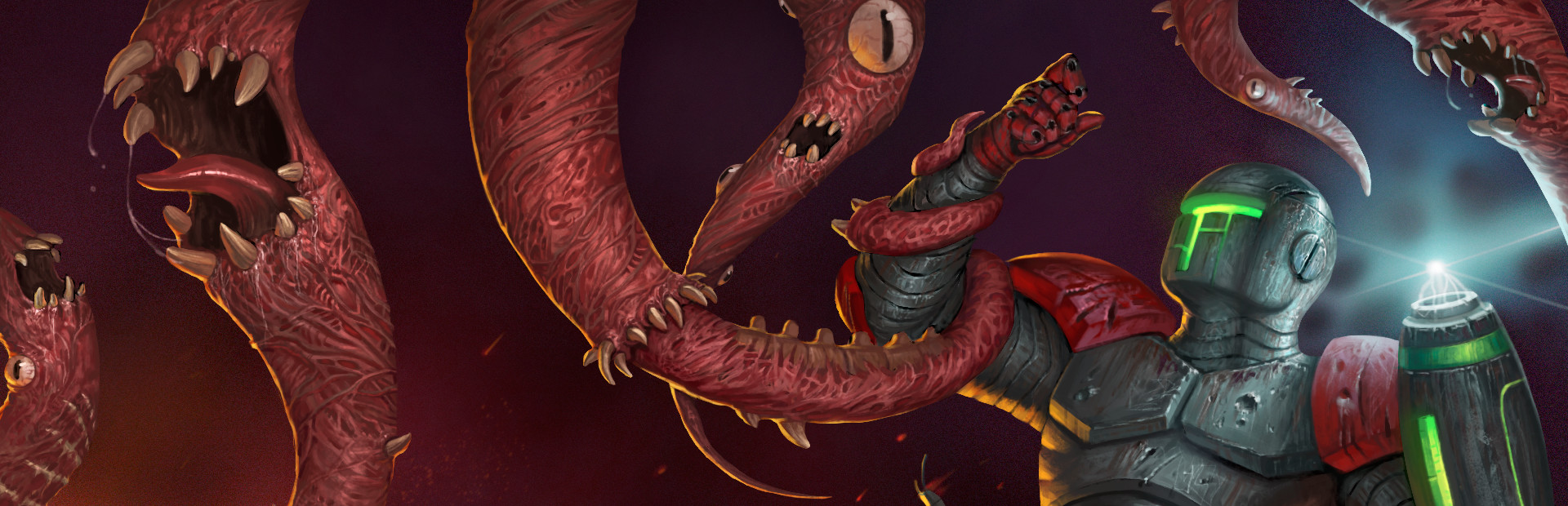
A physics-powered action roguelike. Grab asteroids, catch missiles, and hurl them back at swarming enemies. Build wild loadouts, defeat colossal bosses, and push deeper into a collapsing galaxy.
Our score
Eligible for ranking after all five dimensions are reviewed
Game filed. Review coming soon.
This game has not yet completed our five-dimension review. Explore its details and external material in the meantime.
Video reviews
Reviews and deep dives from YouTube and Bilibili, in every language. Open the original video to watch.
Other voices, for reference.
Archived third-party reviews and community material may refer to different versions. External opinions and ratings are presented separately; consult the original videos for their full context.
Community discussion
A physics-driven twin-stick action roguelite from Crunchy Leaf Games where you grab asteroids, missiles and even torn-off enemy parts with a gravity gun and hurl them back at swarming enemies across a collapsing galaxy.
Players rate it Very Positive on Steam (about 89.7% of roughly 990 reviews) and call it a surprisingly polished, addictive sleeper with a genuinely novel throwing mechanic and tight controls. Critics are more mixed: Metacritic shows a 74 from 7 critics (scores from 90 down to 50), and the low end faults the repetitive loop and slow upgrade pace. The recurring complaints are thin build variety, uneven weapon and power balance, and progression that slows into a grind after the first hours. It left Early Access (launched July 2024) on June 3, 2025 and has kept getting substantial updates (v2.0 Infinity's Edge in March, Steam Deck Verified and performance work in spring), so reviews from late 2025 onward describe a living game rather than an abandoned one.
What players praise
- The grab-and-throw gravity gun is the standout hook: tossing asteroids, reflecting missiles, flinging small enemies into others and ripping weapon parts off enemies feels satisfying and is actually powerful, not just a gimmick.
- Fast, snappy, responsive controls with generous dash i-frames that make you feel skilled rather than hit by cheap bullets.
- Combat pacing: enemies and bosses are not spongy, rooms are bite-sized and the gap between encounters is short, giving a one-more-run compulsion.
- Large weapon and ship variety, with starting loadout choice noticeably changing how a run plays, plus a lot of achievement and challenge-run content.
- Strong audiovisual presentation: gorgeous readable visuals, meaty weapon feedback and a well-liked soundtrack (one player wished it was sold separately).
- Fair-feeling structure: you can win from the very start, with no artificial time limits, so success comes from skill and execution rather than meta stat checks.
- Very active, responsive developer who ships large free updates and acts on player feedback.
- Great value for the price (around $13, often heavily discounted) and works well on Steam Deck after the spring update.
What players criticize
- Build variety feels thin: per-run upgrades are dominated by a few basic choices (attack, armor, throw) and players report too few meaningful choices to craft and evolve a build.
- Balance problems: a few weapons (the void dagger is named repeatedly) and some powers or drones are clearly superior, leaving most other options as wasted space, while some weapons reportedly deal bugged extra damage.
- Difficulty is inconsistent: multiple reviewers find normal rooms too easy once a semi-competent build comes together, even on harder settings, while bosses rely on bullet-hell patterns that a slippery ship handles imprecisely.
- Performance and stability: lag and framerate problems, including on Steam Deck at launch of the Deck mode, and some crashes; a player said the game became near-unplayable before the May update fixed it.
- Opaque systems: unclear item and glitch-bomb effects, a thin guide, and inconsistent resource drops (for example lifegain items bunched in one stage and absent in another) leave players confused.
- Some critics and players find the core loop repetitive, with upgrades arriving too slowly and the driving motivation weak (Cubed3 gave 50).
- Story is called subpar by some players, and a minority call the throwing mechanic mostly a gimmick without much depth.
- Minor bugs reported: pickups needing multiple button presses, and portals or progression occasionally failing to trigger.
Distinctive features
- Gravity-gun physics combat in a twin-stick space roguelite: hurl asteroids, bounce them off walls, catch and return missiles.
- Enemies are multi-part and can be dismantled, letting you rip off weapon parts (such as a laser emitter) with unique properties and use them yourself.
- Throwing is a powerful primary option alongside your chosen weapon, with upgrades like turning thrown objects into homing missile bundles.
- Blueprint-based meta progression: new weapons and ships are found as blueprints and bought, with powers largely unlocked through achievements rather than raw stat upgrades.
- Infinity's Edge endgame mode with Quantum Powers, Corrupted Upgrades and extra final bosses, plus run challenges and story progression.
Divided opinions
- Difficulty: some say it is too easy and shallow, others say the bosses and grind are punishing or cruel.
- The throwing gimmick: praised by most as the best thing in the game, dismissed by a minority as mostly a gimmick.
- Meta and in-run progression: described as a pleasingly restrained, skill-first design by some and as underwhelming or lacking synergies by others.
- Content volume versus repetition: many see a huge amount to do, others see the same loop repeated.
Repetition and friction
- Grind to unlock everything: much of the long-tail content means defeating bosses with every character and repeating challenge runs, which some players describe as a slog.
- Runs and mid-to-late progression slow down, with hours of map clearing needed to collect upgrades before bosses are manageable.
- Shop prices that feel far out of step with income per zone.
- The final boss (Serenity) forcing maximum difficulty frustrated at least one heavy grinder.
- The Infinity mode was called drawn out by a player with close to 100 hours.
Hoped-for improvements
- More meaningful per-run build choices, for example Hades-style weapon-modifying upgrades or multi-beam weapon evolutions, instead of mostly generic stat branches.
- Rebalance weapons, powers and drops so more options are viable and the standout picks stop trivialising rooms.
- Better in-game explanation of item, bomb and power effects (clear tooltips or a real guide) so experimentation is less confusing.
- Smoother economy and progression: shop prices that scale sensibly with what a zone earns, and less forced map-clearing to be strong enough for bosses.
- Continued performance and Steam Deck polish, including UI for handheld play.
- Faster, more rewarding early and mid-game upgrades so runs do not stretch longer and longer and stall progression.
Released in Early Access July 15, 2024 and 1.0 on June 3, 2025 (Windows only; priced about $13). Steam is Very Positive at about 90%. Metacritic has only 7 critic reviews (74) and 4 user ratings (6.3), both tiny samples; OpenCritic has no findable entry. Steam update log: v1.88 (Jan) run challenges and economy rework; v2.0 (Mar 14) Infinity's Edge mode with 8 new weapons, 8 new powers and 3 final bosses; v2.1 (Apr 4) final-final boss and balance pass; v2.2 (May 1) Steam Deck Verified at a stable 60 fps, memory leak fixes and two new room types; v2.22 (Jun 22) bug fixes. Reviews from mid-2026 say performance was poor for a stretch (lag, slideshow on older laptops) and that the May 2026 performance updates fixed it for at least some players, while a minority still report lag or crashes. Developer is praised for listening to feedback. Third-party estimates (Boxleiter-based, order of magnitude only) put gross revenue around $149k and under 20k owners.
Community sources
- Top helpful positive and negative English Steam reviews (local file) ↗
- Steam app metadata: 89.7% positive, release date, tags, revenue estimate ↗
- Steam store page: Early Access July 2024 to 1.0 June 3, 2025, review summary, requirements ↗
- Steam news: v1.88 to v2.22 patch notes (Infinity's Edge, Steam Deck Verified, performance) ↗
- Metacritic: 74 critic score (7 reviews), 6.3 user score (4 ratings) ↗
- Metacritic critic review list with outlet scores and summaries (Loot Level Chill, Cubed3, GameGrin, etc.) ↗
- Third-party revenue estimate (Boxleiter method), about $149k gross ↗
- OpenCritic search; no usable game entry found ↗
Archived creator commentary 1
Third-party summaries based on automatic captions may contain transcription or interpretation errors.
Tier list Part 5 (2026)
Galactic Glitch is a fast, top-down bullet-hell action roguelike where you pilot a spaceship through bubble-shaped rooms inside a simulation. He considers it a really solid, satisfying standard action roguelike and highly recommends it to action fans, even though its physics hook is more marketing than substance. He praises the fluid feel, readable chaos, art and bosses, but finds meta-progression weak and room rewards/currency lacking. He places it at the top of B tier and is surprised it got so little recognition.
What the creator praises
- Extremely satisfying, fluid, fast-paced core gameplay (dash, jump, shoot, grab, throw)
- Bullet-hell action stays readable despite heavy visual effects
- Shooting feedback and visual effects feel great; distinct glitch-verse art style
- Every passive can be upgraded multiple times with impactful effects, enabling cool builds despite limited inventory
- Distinct bosses and great music; biomes feel different
- Rooms are traversed in seconds, giving a Dandy Ace-like but better Cells-style vibe
- Ongoing unlocks (biomes, final bosses, ships, weapons, upgrades) give a real sense of progression; weapons feel different from each other
Issues raised by the creator
- Story was not interesting or easy to follow
- Physics-as-weapon angle feels more like a marketing pitch than a deep mechanic
- Every room is a bubble, which gets somewhat repetitive
- Meta-progression for getting stronger is weak and the tree feels unnecessary
- Currency system and room-clear rewards feel unrewarding
- Balance is a little iffy; heavy reliance on skill makes it easy to win most runs
Design observations
- Throwing objects or enemies within the per-room bubble lets them bounce back off its edge
- Progression comes from unlocking content rather than power, and the true final boss requires extra steps, unlike Dandy Ace where beating the boss ends things