 Game file / ROGUE BY ROGUE
Alina of the Arena
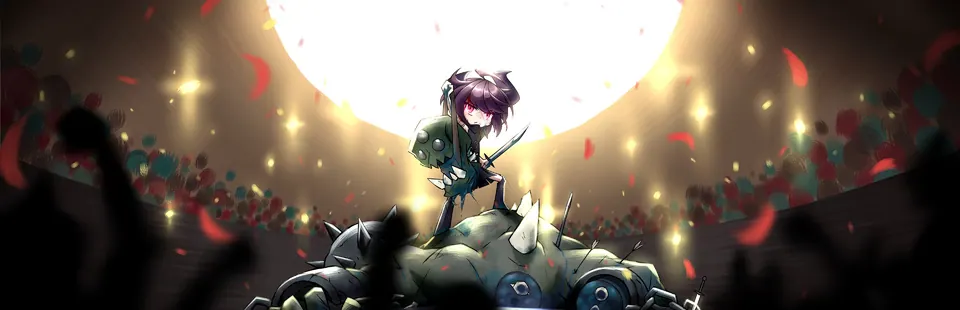
A roguelike deckbuilding tactics game that combines elements from 'Slay the Spire' and 'Into the Breach'. Play as a gladiator to survive. With roguelike deckbuilding and hex-based tactics, no longer bound by simple attack and defense. Make use of dodges and knockbacks to stay alive!
Why this score?
Positioning gives offensive and defensive choices real spatial consequences. The sources suggest that examining positioning usually makes losses instructive, but the card pool and quality of explanations limit further depth.
Machine-translated summary. The original review and its sources are preserved below.
Original text · Simplified Chinese
位置战术让攻防选择有实际空间意义,资料显示失败通常可从站位学习;卡池和说明质量限制了进一步深度。
Core gameplay
Weight 25%8.5 / 10Original text · Simplified Chinese
六角格位移、击退和诱导敌人互伤把每回合变成位置谜题;防御型路线的长战斗会影响节奏。
Builds & strategy
Weight 25%8.0 / 10Original text · Simplified Chinese
左右手武器与卡牌颜色关联,拾取场上物品也提供资源选择;位移牌偏强,职业共享卡池使路线差异有限。
Replayability
Weight 20%7.0 / 10Original text · Simplified Chinese
不同首领和武器组合要求调整站位与出牌,但卡池、职业差异和遭遇规模较小,熟悉后容易回到类似套路。
Randomness & fairness
Weight 20%8.0 / 10Original text · Simplified Chinese
位置操作能化解攻击,资料中有挑战公平、难度可按局选择的反馈;部分效果描述含糊会导致非预期的选牌后果。
Polish & usability
Weight 10%7.0 / 10Original text · Simplified Chinese
快照肯定 PC 动画、音效及运行表现;关键词说明不充分,且主机操作和小尺寸界面存在反馈,跨平台体验未复测。
- Reviewer
Original text · Simplified Chinese
Rogue by Rogue · AI 资料评测- Version reviewed
Original text · Simplified Chinese
具体构建未知;以所引资料描述的版本为准
Scope and limitations
Original text · Simplified Chinese
未进行试玩;分数是依据已收录评述与社区具体反馈作出的主观资料评测。旧反馈跨版本、部分原始材料为不可重开的本地快照;本次 Steam 核查仅确认玩法与功能,未复测平衡、性能或报告的故障是否仍存在。
Review sources 02
- 01Archived materialView archived external material ↓
Original text · Simplified Chinese
收录评论与社区资料(2026-10-01 快照)
使用 作者观点摘要 的 Tier list Part 2 (2024) 的具体优缺点,以及 玩家好评、玩家批评 与 资料核查说明;不使用旧等级、外部分数或销量反推。
- 02Web sourceView original ↗
Original text · Simplified Chinese
Alina of the Arena · Steam 官方商店
2026-10-08 访问。核对六角格战术、借敌人互伤、随机关卡与双手装备系统。未据商店介绍推定性能或故障已修复。
Video reviews
Reviews and deep dives from YouTube and Bilibili, in every language. Open the original video to watch.
Other voices, for reference.
Archived third-party reviews and community material may refer to different versions. External opinions and ratings are presented separately; consult the original videos for their full context.
Community discussion
A hex-grid roguelike deckbuilder by PINIX where you play a gladiator and use cards, dual-wielded weapons, dodges and knockbacks in a Slay the Spire meets Into the Breach tactics system.
Players like it a lot: Steam shows Very Positive (about 91.5 percent of roughly 3,970 reviews) and many call it their favourite Slay the Spire-style game because hex positioning adds real depth. Critics are warmer than lukewarm but thin on the ground: Metacritic lists 76 (about 11 critic reviews across platforms, 6 on Switch) and OpenCritic has a 75 top-critic average from 8 reviews, with only 50-57 percent recommending. It began in Early Access in January 2022 and went 1.0 on Steam in October 2022, then reached consoles in November 2023. Recurring complaints are limited content, samey classes, and a thin presentation. Some reviewers say the developer has stopped updating it, though it remains a well-priced, well-balanced tactics deckbuilder.
What players praise
- Hex movement is central: pushing enemies, dodging and positioning make fights feel like tactical puzzles, which reviewers say gives it more depth than Slay the Spire's simple block
- Dual-wield equipment system (daggers, sword and shield, two-handed weapons) with card colours tied to each hand adds build identity
- Soundtrack widely praised, with the Act 2 boss track singled out by a 100 percent completion reviewer
- Pixel art, crunchy sound effects and animations feel polished and run smoothly, including on controller
- Balanced and challenging but fair; difficulty can be set per run without losing unlock progress, and high difficulty and max-stage challenges extend play
- Card synergies and cursed weapons enable satisfying combo turns and occasionally broken runs
- Free demo, and a low price (often about 7 USD on sale) that reviewers call good value
- Free-action tossing of rocks and dropped weapons from the ground is an appreciated small tactical layer
What players criticize
- Card and effect descriptions are vague (burn, focus, stacking wounds), so you cannot make informed decisions and regret picks
- Limited content: small card pool, few bosses (about 7 major), and build-defining cards become obvious within a few runs
- Classes are similar, sharing card pools with thin differences; starting class Strike/Defend cards are just renamed with the class name
- Event encounters are text only, often just trade money for an item, with no illustrations or aftermath images
- Almost no story or worldbuilding until the ending
- Console reviewers cite awkward controls, weak UI and a small dim sprites problem on Switch; no touch support
- Some players call the developer inactive and the game effectively abandoned; Steam Workshop is listed but content is thin
Distinctive features
- Explicit fusion of deckbuilding with Into the Breach-style tactical grid movement, including knockbacks and dodges instead of simple attack/defend
- Hand-coloured cards: equipment in left and right hands and colour switching shape what cards do
- Classes styled like Dark Souls starting builds (Pyromancer, Deprived, Slave and others), encouraging themed builds
- Dropping and throwing ground objects as a free action
- Static arena with no map RNG, so all variation comes from cards, enemies and events
- Per-run difficulty selection that keeps unlock progress
Divided opinions
- Build variety: some love the focused class identities; others find classes too limiting versus Slay the Spire
- Difficulty: some call it brutal but rewarding, others call combat easy; also whether Veteran-level scaling is interesting
- Value: praised as a bargain on sale but one reviewer rejected the roughly 12.49 EUR price as too short and repetitive
- Whether the thin story and event presentation matters, given the fast gameplay loop
Repetition and friction
- Long runs: normal runs reportedly take 1 to 1.5 hours and some up to 2 hours
- Early game can be punishing because you start with few movement cards and depend on drawing them
- Colour-switching and control schemes are confusing for newcomers, especially on a gamepad
- Repeated fights and bosses feel repetitive after the first several runs
Hoped-for improvements
- Write precise, numeric card and status text (for example deals 1 per stack per turn)
- Add illustrated events with outcomes and a bit more narrative framing, such as intros or boss VS screens
- Give each class distinct starting cards and names, and widen the card pool and viable builds
- Add more content: bosses, enemy variety, arenas (there is only one board type) and more Workshop/mod content
- Improve tutorial coverage and onboarding for the colour-switching and movement rules
- Rebalance weapons (katana reported strong, ranged and heavy weapons weak) and make higher difficulties add mechanics, not just stat bumps
Early Access on PC/Mac began January 2022 with 1.0 on Steam October 13, 2022 at 14.99 USD. Consoles (PS4/PS5, Xbox, Switch) launched November 23, 2023; the Metacritic 76 shows on the page with Switch as the most-reviewed platform (6 of about 11 critic reviews); Metacritic user score is tbd. Steam reception has stayed Very Positive, with recent reviews in 2025-2026 still recommending it and mentioning it in the context of Slay the Spire 2's early access. Aggregator summaries and some reviews say the developer stopped updating it long ago. Third-party estimates (Steam revenue calculator, Boxleiter method, unaudited) put gross revenue around 1.85M USD and SteamSpy owners at 200k-500k. Steam lists no Metacritic score.
Community sources
- Top helpful positive and negative English Steam reviews (local file) ↗
- Steam store data, review counts, SteamSpy and revenue estimates ↗
- Steam store page ↗
- Reception table and release platforms/dates ↗
- OpenCritic score and critic list ↗
- Metacritic Switch score ↗
- Switch review with 7/10 and presentation and control critique ↗
- Aggregated Steam review summary of praise and complaints ↗
- Estimated gross and net revenue ↗
- Announcement coverage describing Slay the Spire and Into the Breach inspirations ↗
Archived creator commentary 1
Third-party summaries based on automatic captions may contain transcription or interpretation errors.
Tier list Part 2 (2024)
Alina of the Arena is a deck-building roguelike where cards are used to move and attack on a tactical board, blending Slay the Spire style deckbuilding with Into the Breach style positioning. He discovered it through a stream viewer's recommendation and fell in love with it after 10-15 hours. He feels the board gimmick is strong enough to stop it from being a Slay the Spire clone while staying close to its familiar structure. He places it in A tier and thinks it could grow with more content.
What the creator praises
- A unique board-movement mechanic gives the game its own identity while keeping Slay the Spire familiarity
- Cards are well designed and support many different builds
- Each character starts with a unique deck and abilities, so runs feel different
- Three floors that each look visually different give a sense of progression
- Bosses have unique mechanics and encounter variety avoids repetition
- A surprising story twist at the end and fun lore
- Content looks easy to extend with new cards, characters and bosses
Issues raised by the creator
- Balance is off: movement-related cards are extremely powerful and can carry a run
- Fights can run long, especially with defensive builds
- Fewer cards and builds than Slay the Spire; builds may converge over many hours
- No unique card pools per character, only unique starting decks
Design observations
- The board and movement mechanic is the gimmick that differentiates it from Slay the Spire clones
- He argues modern deckbuilders need a unique mechanic or they feel like clones
- Keeps near-identical cards and keywords to Slay the Spire while designing around the board