 Game file / ROGUE BY ROGUE
Die in the Dungeon
Fight your way through a mysterious dungeon in this deck-building, turn-based roguelike game where you don't use cards, but dice! Deal with enemies by combining powerful dice on your board, boost their effects with magical relics, and risk it all hoping for a good roll on unexpected encounters.
Our score
Eligible for ranking after all five dimensions are reviewed
Game filed. Review coming soon.
This game has not yet completed our five-dimension review. Explore its details and external material in the meantime.
Video reviews
Reviews and deep dives from YouTube and Bilibili, in every language. Open the original video to watch.
Other voices, for reference.
Archived third-party reviews and community material may refer to different versions. External opinions and ratings are presented separately; consult the original videos for their full context.
Community discussion
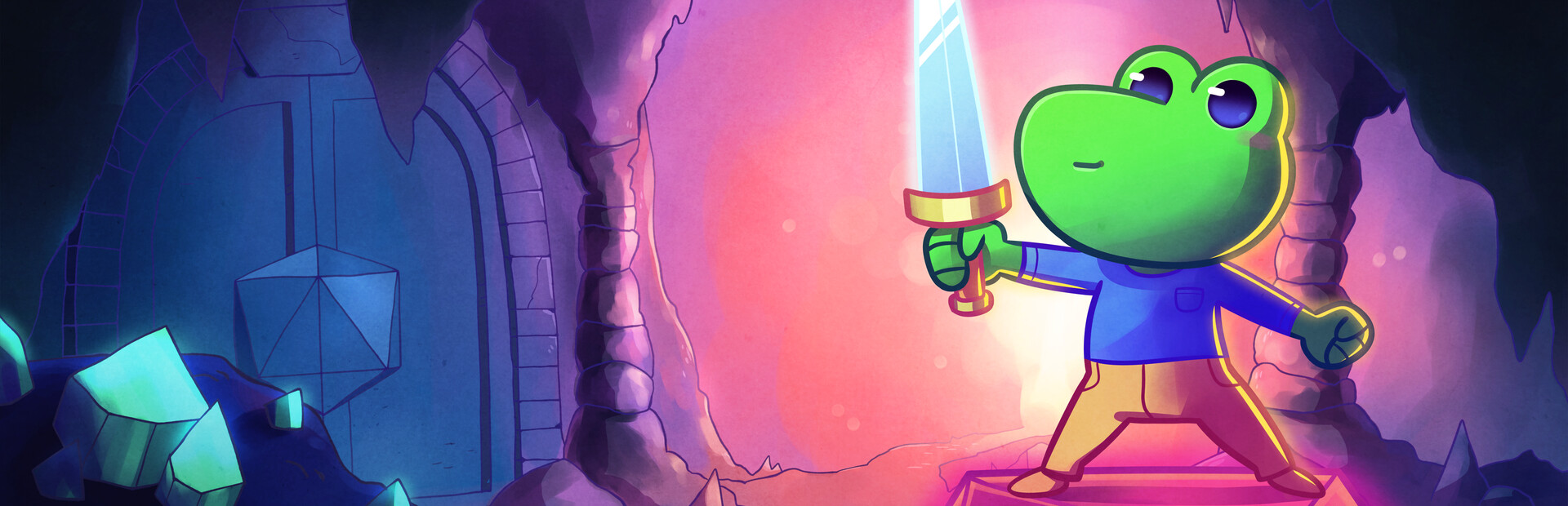
A turn-based roguelike deckbuilder by ATICO where you use dice instead of cards, slotting attack, defense, healing and booster dice onto a character-specific board and boosting them with relics, starring cute pixel-art frogs fighting insects.
Players like it a lot: Steam shows Very Positive (about 92% of roughly 3,600 reviews) and the developers and publisher (HypeTrain Digital, Sidekick Publishing) got it through Early Access (started Feb 21, 2025) to a 1.0 launch on May 1, 2026, with Switch also mentioned. Critics coverage is thin (two OpenCritic reviews, both very positive, and no Metacritic score). Praise centres on the dice-on-a-grid puzzle, pixel art and music, and an approachable on-ramp for genre newcomers. The recurring complaints are slow, long runs, builds converging on the same few strategies, enemies that do not scale so stalling or full-blocking works, and a lack of character and build variety. Reviewers who stay long (endgame players) are markedly more positive than those who bounce in the first hours.
What players praise
- Swapping cards for dice placed on a shaped board turns each turn into a spatial optimisation puzzle; reviewers call it a fresh take that changes how you plan, not just a reskin
- Pixel art and character/enemy design (cute frogs vs. bugs) are the most universally praised element, along with a well-liked soundtrack
- Combos can get very deep, for example once you can change faulty dice; long-time players say the synergy space is expansive
- Approachable: tooltips get new players going quickly, and it is described as a good gateway into the genre
- Four characters with different board shapes and sizes, plus artifacts and curses that alter how dice, board and enemies interact
- Events can be played around with your dice and many can be skipped if your dice are strong, which players find more engaging than event screens in peers
- Active, community-minded dev team: enemy design contests and community lore writing, regular Early Access updates, free Origins demo
- Good value at $14.99 with lots of hours of playtime reported by fans (some with several hundred hours)
What players criticize
- Runs and individual fights drag; many reviewers report runs of 60-90+ minutes, with enemies that have very high HP and low damage and no pressure to end fights
- Board readability degrades late: stacked effects on one tile and huge boosted numbers become hard to parse, to the point of not knowing what happened in some fights
- Builds converge on one or a few viable strategies, often stacking block and infinite or near-infinite combos; many dice offered in early acts feel like they make your deck worse
- Balance swings between trivial and brutal: some players finish with block in the hundreds and lose almost no runs, while others hit a wall at the higher ascension levels (D3 to D8)
- Characters feel too similar to some players, especially the two block-focused ones, and there are few non-attack/block dice types in practice
- Relics are seen as either underwhelming or game-solving, with weak payoffs for build themes such as glass or gold dice
- Accessibility gaps: constant looping animations that cannot be turned off triggered migraines/motion sickness for some, and the pixel font is hard to read for some; Steam Deck controller support was reported as poor
- Lore is thin in game with much of it reportedly living in the Discord
- Several negative reviewers say it lacks staying power or 'sauce' compared with Slay the Spire, Peglin or Astrea: numbers just go up, decisions repeat each turn, and progression feels flat
Distinctive features
- Dice rather than cards, placed into a per-character grid board where position and adjacency matter
- Attack, defense, healing and booster dice colour-coded, with boosters and copy effects that feed off neighbours
- Starting gear and dice that are worth keeping all run, unlike the disposable starter cards in many Slay the Spire-likes
- Began as a 2021 game jam entry and itch.io demo and grew into a Steam release with a community-involved development style
- Frogs-versus-bugs presentation with a gambling-flavoured risk/reward layer on events
Divided opinions
- Difficulty: some say it is far too easy and easy to break, others find the ascension levels brutal
- Run pace: some enjoy the calm, strategic tempo; others compare it unfavourably to 30-minute Slay the Spire runs
- Build variety: fans praise the combo depth while critics say choices are an illusion and everything converges
- Longevity: players with hundreds of hours love it, while a notable minority lose interest within 5-10 hours
Repetition and friction
- Long, slow combats and runs with simple decisions repeated every turn
- Levelling characters to unlock content and pursue completion, which fans themselves call grindy
- Having to re-read dice descriptions and edge cases each turn, which makes it feel like homework to some
- Late-game number inflation and high-difficulty negative modifiers that push toward infinite-combo builds
- Persistent animations and small pixel text for motion- or migraine-sensitive players
Hoped-for improvements
- Add a fast mode or option to skip or speed animations to shorten long runs
- Improve readability: clearer display when several effects share a tile, and a breakdown view showing how relics and modifiers change each die's numbers
- Rebalance so more builds are viable, and so blocking every turn or rejecting all dice rewards is not the dominant approach; make enemies scale or add pressure to long fights
- More dice types, characters, relics with bigger build-around payoffs, and more run-to-run variety
- Add an accessibility mode (toggle for wiggling animations, readable font) and proper Steam Deck controller support
- Reduce the grind of levelling every character for unlocks and 100% completion, and make higher difficulties less reliant on cheesy infinite combos
Early Access launched Feb 21, 2025 on PC after a 2021 game jam and itch.io demo history. Review counts grew from about 2,900 (92%) during Early Access to about 3,600 (92%) after the 1.0 release on May 1, 2026. Dev updates continued through Early Access (for example an update called Challenges on March 3, 2026), and later additions such as potions and boss objectives got mixed responses because some objectives lengthen fights. Some reviewers who replayed after 1.0 said their earlier complaints about slowness and sameness still stood, and the accessibility request for reduced animation appeared unchanged at 1.0. Platforms: Windows and Mac on Steam, GOG version, and a Switch release is referenced by Rogueliker. Metacritic has no critic score; OpenCritic lists only two reviews with no aggregated score returned.
Community sources
- Top helpful positive and negative English Steam reviews (local file) ↗
- Steam appid, review totals, SteamSpy owner range, revenue estimate (local file) ↗
- OpenCritic page: two critic reviews (Video Chums 4/5, LadiesGamers) ↗
- Metacritic page showing no critic reviews yet ↗
- Rogueliker Early Access review, very positive, unscored ↗
- LadiesGamers review: praise for dice system and art, uneven difficulty noted ↗
- Steam review aggregation: repetition, RNG and limited variety complaints; endgame players 97% positive vs 76% in first 2 hours ↗
- Third-party revenue estimate ↗
- Switch release reference ↗
- GOG changelog forum, evidence of update cadence ↗
Archived creator commentary 1
Third-party summaries based on automatic captions may contain transcription or interpretation errors.
Tier list Part 4 (2025)
Die in the Dungeon is an early-access, turn-based roguelike dice game where you place unique dice on a board and combine their effects to fight through floors to a final boss. He finds it genuinely unique and has had a blast, noting a huge amount of content and regular updates. However, it is overwhelming for new players, the small-text art style hurts readability, balance is uneven, and runs can drag. He places it in high B for now, with potential to rise at full release.
What the creator praises
- Every die has a unique effect and adjustable numbers, giving deep customization of dice and board
- Three characters with different boards, starting dice and passives make each run feel like a new adventure
- Lots of content and regular updates keep it fresh on return visits
- Passive relics and newly added potions add variety and distinct playstyles
- Events have unique sprites and animations, immersing the player in the dungeon crawl
- Enemies interact with your board by placing things on it, adding strategic depth
- Dice design works around the luck handicap of dice games in an interesting way
Issues raised by the creator
- Overwhelming at start due to many keywords and specific mechanics
- Art style is great but small, scattered text makes dice icons and descriptions hard to read and track
- Finding new dice later in a run is less satisfying than finding rare cards in Slay the Spire
- Defensive or weak builds do not die but make runs extremely long, e.g. 15-minute boss fights
- Some mechanics like terrain dice are inherently overpowered, showing balance difficulty
- Elites are just multiple waves of normal enemies, which wastes time versus one bigger, scarier enemy
Design observations
- Dice as the core deckbuilder-like resource, placed on a board with enemy-interacting board effects
- Every die has its own effect and numbers rather than standard d4/d6/d8
- Events presented with bespoke sprites and animations rather than plain text
Updated opinion
Early access rating; he says it could move up at final release.