 Game file / ROGUE BY ROGUE
Cobalt Core
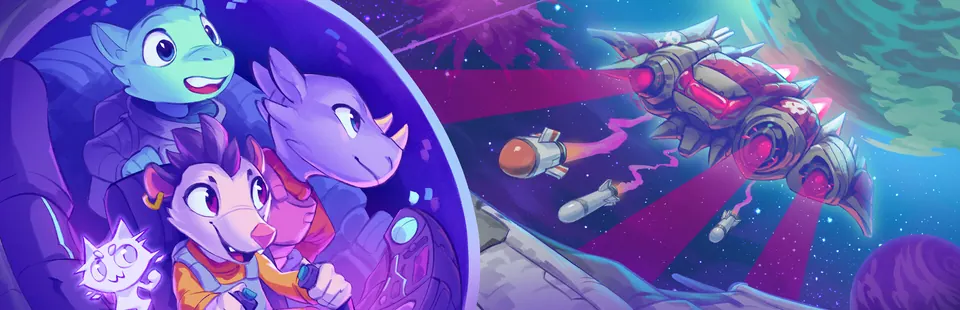
A sci-fi roguelike deckbuilder with a deep new single-axis spin on tactics games! Dodge missiles, line up your cannons, and blast 'em out of the sky... Then get to the bottom of these time loops, before it's too late!
Why this score?
Movement along a single axis ties dodging and attacking into card-play strategy, with clear information and smooth controls. A limited encounter pool and overly strong movement-based defense cap its replayability.
Machine-translated summary. The original review and its sources are preserved below.
Original text · Simplified Chinese
用单轴位置把闪避和攻击统一到出牌策略,信息清晰且操作流畅;有限的遭遇池和偏强移动防御限制重玩上限。
Core gameplay
Weight 25%8.5 / 10Moving left or right affects both dodging and cannon alignment, making card order and ship position a clear turn-by-turn puzzle. Route choices on the map are comparatively less engaging.
Builds & strategy
Weight 25%8.5 / 10Combining three crew members’ decks, ship rules and branching card upgrades creates varied resource systems. Movement-based defense often outperforms shields, and some cards become routine first choices.
Replayability
Weight 20%7.5 / 10Changing the crew and ship requires a new plan for movement and damage, while daily modifiers can add constraints. Enemies, events and final bosses are relatively fixed, so surprises diminish as the content becomes familiar.
Randomness & fairness
Weight 20%8.5 / 10Enemy firing previews make losses easier to trace to planning and responses to card draws, with almost no need to grind permanent stats. Some defensive approaches are weaker, and experienced players may find the difficulty curve rather flat.
Polish & usability
Weight 10%8.5 / 10The sources consistently praise clear interface, animation and audio feedback, along with a brisk pace of play. New players still need to learn cannon and hull rules; no extra credit is given for performance that we have not tested.
- Reviewer
- Rogue by Rogue · AI-assisted source research
- Version reviewed
- Exact build unknown; this review covers the versions described by the cited sources.
Scope and limitations
No hands-on playtest was performed. This score is a subjective assessment of archived reviews and specific community feedback. Older feedback spans different versions, and some original material survives only as local snapshots that cannot be reopened. The Steam check confirmed mechanics and features only; balance, performance and whether reported bugs still occur were not retested.
Review sources 02
- 01Archived material
Archived reviews and community material (October 1, 2026 snapshot)
View archived external material ↓Uses specific strengths and weaknesses from the archived creator commentary for Tier list Part 3 (2025), together with community praise, criticism and verification notes. Historical tiers, external scores and sales are not used to infer the rating.
- 02Web sourceView original ↗
Accessed October 8, 2026. Checked single-axis ship movement, targeting weak points, decks combining three crew members, upgrade branches and daily challenge modifiers. The description was not treated as proof of performance or bug fixes.
Video reviews
Reviews and deep dives from YouTube and Bilibili, in every language. Open the original video to watch.
Other voices, for reference.
Archived third-party reviews and community material may refer to different versions. External opinions and ratings are presented separately; consult the original videos for their full context.
Community discussion
A sci-fi roguelike deckbuilder by Rocket Rat Games in which you pilot a spaceship with a three-character crew through a time loop, dodging enemy fire by moving left and right to line up cannons.
Cobalt Core is very well received by both critics and players: 96% positive on Steam (Overwhelmingly Positive, about 4,400 reviews), Metacritic 94 and an OpenCritic top critic average of 89 with 100% of critics recommending. Reviewers present it as a compact, tactical take on the Slay the Spire formula, with the lateral-movement mechanic, crew-mixing and charming writing as the standouts. The recurring caveats are content volume and difficulty: several players and critics say it is easy even on top difficulty, runs repeat the same events and bosses, and the unlock arc is short. It is not early access, and it got free updates after launch (1.1 added enemies and alternate bosses, 1.2 in Jan 2025), a Mac port in July 2025 and Linux support reported in Aug 2025. It was nominated for Strategy/Simulation Game of the Year at the 27th D.I.C.E. Awards.
What players praise
- Movement is the core hook: dodging incoming missiles while lining up your own cannons adds a tactical puzzle layer absent from other deckbuilders (FTL / Into the Breach flavour).
- Crew mixing: picking three of the characters to form your starting card pool gives a lot of combinations and distinct archetypes (drones, heat, corrosion, shields, infinites).
- Characters and writing: crew members banter reactively based on cards played, damage taken and who is paired together; widely called charming, funny and endearing.
- Enemies telegraph their next shots, so outcomes feel driven by player choices and planning rather than pure luck.
- Snappy, polished feel: UI, sound design and animation make runs fast and satisfying.
- Time-loop story told through unlockable memories ties neatly into the roguelike structure and pays off; some reviewers say the story is better than typical for the genre.
- Multiple ships with their own rules and playstyles, none strictly better than the starter, plus daily challenges and a codex that encourages completionism.
- Minimal meta-progression: no grinding for power, you win by getting better; a small team (three people) delivered an unusually polished game.
What players criticize
- Limited content: the same events, enemies and bosses recur every run, card and artifact pools are smaller than Slay the Spire's, and players report seeing everything in roughly 10-20 hours.
- Too easy: multiple reviewers beat hard and harder difficulties within a few runs and say they must self-handicap with weaker crews or ships to be challenged.
- Same-y builds: all of a character's cards unlock immediately, so the best cards become obvious and runs converge.
- Map traversal and pathing are considered uninteresting compared with other genre entries.
- Shield feels underpowered relative to movement/dodging, narrowing viable defensive strategies.
- Critics noted boss fights lack randomness and the total unlock arc is short compared with peers.
- Some players find the core loop of shifting left or right with hit-or-miss draws unengaging and feel cards/effects are underwhelming.
Distinctive features
- Single-axis tactical combat: you slide left or right to dodge and line up shots, rather than just playing cards against a health bar.
- Your deck is built from the three crew members you choose, making crew selection a pre-run strategic layer.
- Dynamic crew dialogue that reacts to specific game state, inspired by Star Trek and Reigns.
- Time-loop framing with story memories unlocked through runs, inspired in part by Inscryption's meta-awareness.
- Ships change the ruleset of the run (different meta rules), and the game is compact rather than sprawling.
- Distinct cobalt-blue pixel-art look with a light-hearted tone and serious undercurrents.
Divided opinions
- Difficulty: some celebrate that skill reliably wins, others find even the hardest mode too easy and then feel there is little left to do.
- Movement mechanic: loved as fresh and tactical by most, but a minority finds moving left/right and hoping for the right card dull or RNG-heavy.
- Value: fans put hundreds of hours in (one reviewer 520 hours, another calls it their favorite roguelike), while others call it thin for about $20 and recommend waiting for a sale.
- Versus Slay the Spire: some see it as a mini StS clone, others rank it above StS.
Repetition and friction
- Repetition: seeing the same events and enemies every run becomes tedious after the first dozen runs.
- Feeling underpowered in fights and chipping away at enemies, with no Balatro/Monster Train-style moment of unlocking an overpowered build (one 16-hour reviewer).
- No undo for misclicks and having to inspect each card to see upgrade results.
- Some find the unlocks spaced both too far apart and too thin, and the story not compelling enough to motivate unlocking.
- RNG-driven draws can leave you without the movement or range card you need, which some reviewers find frustrating.
- Short playtime-to-content ratio: several negative reviewers (8-10 hours) beat hard or harder difficulty within a few runs and call it thin for the price, wanting a steep sale.
Hoped-for improvements
- Add much more content: players ask for roughly double or triple the cards, enemies, events, bosses and gimmicks (events and ship count were singled out in reviews).
- Offer harder difficulty tiers or modifiers so experienced players are challenged without self-handicapping.
- Add randomness or variation to boss encounters and more alternate bosses per zone.
- Make map traversal more meaningful (more interesting route decisions).
- Add an undo option and show card upgrade outcomes without having to click into every card.
- Rebalance shield versus movement and further distinguish the crew so fewer cards are obvious picks.
Launched Nov 8, 2023 on Windows and Switch after an October 2023 Steam Next Fest demo, and was praised at launch as a standout from a tiny three-person team. Metacritic critic score is based on only 5 reviews and the user score (7.7) on only 23 ratings, so treat them as thin samples; Steam (96%, 4.4k reviews) is the more robust signal. Post-launch: update 1.1 added six new enemies and alternate bosses, update 1.2 arrived Jan 2025, macOS port July 2025, and Linux support reported Aug 2025; the game is not early access and is not abandoned, though no major expansion was found. Steam-side estimates suggest roughly 100-200k owners and about $1.65M gross revenue (third-party Boxleiter-style estimate, order-of-magnitude only). Recent (2025-2026) Steam reviews still praise it heavily while repeating the same complaints about content depth and low difficulty; some players mention modding as a way to extend it. Nominated for Strategy/Simulation Game of the Year at the 27th D.I.C.E. Awards.
Community sources
- Top helpful positive and negative English Steam reviews (local file)
Research archive; no public link available.
- Steam app data: 96% positive, Metacritic 94, SteamSpy owners, revenue estimate
Research archive; no public link available.
- OpenCritic: 89 top critic average, 100% recommend, Eurogamer/PC Gamer/RPS quotes ↗
- Metacritic: 94 Metascore (5 reviews), user score 7.7 (23 ratings) ↗
- Development, release dates, Mac port, D.I.C.E. nomination, critical reception ↗
- Review: movement mechanic praised; limited events and few ships noted ↗
- PC Gamer review (87); page content not readable, score and pull quote taken from OpenCritic listing ↗
- Switch update history (1.1 enemies and bosses, 1.2 Jan 2025) ↗
- Linux support news Aug 2025 (surfaced via search; not fetched) ↗
- Third-party revenue estimate (about $1.65M gross) ↗
Archived creator commentary 1
Third-party summaries based on automatic captions may contain transcription or interpretation errors.
Tier list Part 3 (2025)
Cobalt Core is a space-themed, turn-based deck-building roguelike where cards move your ship and fire its cannon, with each crew combination bringing its own mechanics. He loves it, calling out its soundtrack, story-driven encounters and vibe. He places it in high A for now, saying it sits between low S and high A, and keeps S for his all-time favorites. He may revisit whether it deserves S later.
What the creator praises
- Soundtrack is one of the best he has heard in a roguelike; he listens to it on its own
- Easy-to-grasp but strategic core mechanics: cards move the ship and shoot depending on where the cannon is
- Characters have distinct mechanics (overheat cards, auto-firing turrets), giving strong replayability via ship and crew choice
- Encounters each tell a story; events and relics are fantastic roguelike elements
- Every enemy fight feels unique, with its own mechanics and strategies to adapt to
- Memories unlocked from beating runs add emotional lore; very homey, immersive vibe
- Large amount of content that takes a long time to exhaust
Issues raised by the creator
- Not intuitive at first; trickier to comprehend unless you are used to deck-builders and turn-based games
- Some characters are more complicated or less fun than others
- Final boss is underwhelming; he wishes there were different possible final bosses
- Once everything is discovered, the joy of finding new events fades
Design observations
- Ship-positioning combined with cards is a mechanic you don't see every day in deck-builders
- Unlocking crew memories as a reason to push for a full run, adding lore and emotional payoff
- Enemies can converse with you and each has unique mechanics
Updated opinion
Placed as high A for now; he says he will think later about whether it deserves S.
Related guides
All guides ↗Cobalt Core vs Wildfrost: ship movement or companion tactics?
Compare Cobalt Core and Wildfrost through positioning, turn rhythm, builds and unlocks. Choose the card battler whose everyday decisions appeal to you.
Similar gamesGames Like FTL for Turn-Based Play: Cobalt Core or Into the Breach?
Want FTL-style decisions with turns? Compare Cobalt Core’s card-driven ship battles and Into the Breach’s mech tactics, including what each keeps and changes.