 Game file / ROGUE BY ROGUE
Inkshade
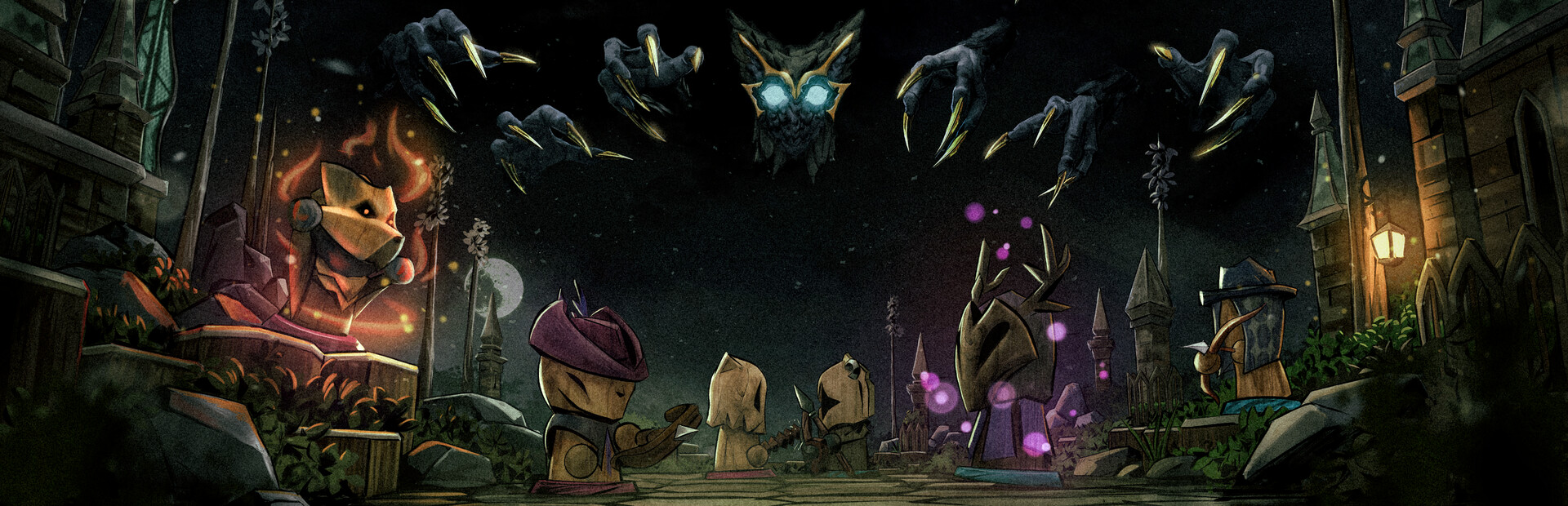
Inkshade is a turn-based tactics game carved out of strange wooden miniatures, wrapped in a web of locked rooms, and orchestrated by an otherworldly game master. Victory is not guaranteed, and the only constant is the cruel black ink that flows within the pieces.
Our score
Eligible for ranking after all five dimensions are reviewed
Game filed. Review coming soon.
This game has not yet completed our five-dimension review. Explore its details and external material in the meantime.
Video reviews
Reviews and deep dives from YouTube and Bilibili, in every language. Open the original video to watch.
Other voices, for reference.
Archived third-party reviews and community material may refer to different versions. External opinions and ratings are presented separately; consult the original videos for their full context.
Community discussion
A first-person, dark-atmosphere turn-based tactics roguelite by Studio Vezelle where you command wooden board-game miniatures against a malicious game master, with locked-room escape puzzles between battles.
Steam players rate Inkshade Very Positive (about 87% of roughly 636 reviews, Steam listing as of the data pull), driven by its atmosphere, sound and art, and the creepy, sardonic game master. The common caveat is that the tactics are shallow and the roguelite loop is grindy: units differ mostly by stats and a few broken-strong upgrade paths trivialise late fights. It is constantly compared to Inscryption, usually unfavourably on depth but favourably on vibe. There are no critic reviews: Metacritic has a page with zero critic reviews and only 2 user ratings, and no OpenCritic entry was found. The game is a finished 1.0 (not early access) that got several post-launch patches in Aug-Sep 2025 (lantern toggle, contrast slider, walk speed, new challenge mode), and still receives positive reviews into 2026.
What players praise
- Atmosphere, art direction, lighting and sound design (the wooden 'bonk' of pieces, battle themes, end-credits track) are the most consistently praised element
- The game master is a memorable, sardonic and malicious narrator whose worldbuilding and banter give the run a sense of story
- Escape-room style puzzle sections in locked rooms give a satisfying break from combat and several reviewers found them clever and tough
- Tactical board is simple and readable: pieces cannot pass through each other, so bottlenecks, shielding and elevation matter
- Collecting and upgrading new pieces feels rewarding, and tense battles where you could lose your whole roster give real dread
- Strong Inscryption-like vibe with different mechanics (mid-run recruiting of defeated enemies, hex-grid tactics) that some find a fresh spin
- Steam Deck works well per at least one reviewer (minor remapping), plus accessibility options like adjustable difficulty and colour alternatives
What players criticize
- Tactical depth is shallow: units are differentiated almost entirely by five stats (movement, health, range, damage, defense) and only a few have special abilities
- Balance is exploitable: stacking armour/attack on one or two pieces (the Wretch is repeatedly named) makes most enemies and bosses trivial, so strategy falls away
- Enemy AI is passive and only engages when a piece is in range, enabling simple luring tactics
- Very dark visuals; even with lantern and brightness options, some players cannot see enemy units and felt unfairly killed
- Performance and stability complaints: low fps on mid-range GPUs, some maps heavy, and one reviewer reported frequent crashes on an older Win10 PC (fine on a newer machine)
- Controls can be clumsy: passing a unit's turn with a triple click is easy to trigger accidentally, no clear attack-range preview for ranged units before moving, unit names hard to see
- The narrator talks a lot and dialogue cannot easily be skipped even after many repeats
- Story and character connections are thin and the ending left some players unsatisfied; limited replayability after finishing
Distinctive features
- Combines first-person escape-room exploration of locked rooms and an airship setting with a turn-based tactics board game run by a hostile game master
- Pieces are wooden miniatures on a physical-feeling board with hex grid, elevation and height effects
- Roguelite meta-progression through spending scrip on permanent upgrades to a collected roster, plus a mid-run recruitment system for defeated enemies
- A post-campaign challenge mode (including a Monomanipulation mode for single-unit runs added in Sep 2025) that players say is closer to a classic roguelite
- Unlocking new pieces is tied to solving puzzle rooms, and opening rooms is tied to progressing through battles
Divided opinions
- Inscryption comparison: some see a worthy atmospheric cousin, others call it a shallow imitation without Inscryption's mechanical depth
- Difficulty: some enjoy brutal early hours and tense fights, others find it grindy early and then trivial once an overpowered build is found
- Puzzle rooms: praised as a highlight by some, called shallow or unclear by others
- Narrator and story: charming and creepy to some, repetitive and flat to others
Repetition and friction
- Grind: you need upgrades to win fights and need to fight (and often lose) to earn upgrade currency; reviewers cite only about 15-20 scrip per failed run versus 50 for a single point of damage
- Dying can send you back large sections, keeping pieces and upgrades but losing run progress, which feels heavy in mid/late game
- Enemies and early encounters scale with progress, so knowledge and skill matter less than how many upgrades you bought
- Spreading upgrades across many pieces is a trap; new players may have to restart or soft-lock themselves on harder settings after a reset
- Long runs with repetitive combat and a chatty narrator during tutorial/first-hour failure scripting
- Darkness and camera behaviour causing eye strain or motion sickness for some
Hoped-for improvements
- Add more unit abilities and build variety (area attacks, taunt, summons, status effects) so pieces differ beyond stat numbers
- Rebalance upgrade costs and scaling so one maxed piece or armour stacking cannot trivialise the game, and so early grinding feels less punishing
- Improve brightness/visibility and add camera options (decouple camera from mouse, manual camera toggle) to address eye strain and motion sickness
- Fix the unit-pass input (allow un-passing or use a less accident-prone control) and show attack range and unit names more clearly
- Let players skip or shorten repeated narrator dialogue
- Optimise performance and stability, and consider modding/community map support or more backstory content (suggested by one reviewer)
Released Aug 14, 2025 on Windows only (no Mac/Linux) at $19.99, developed and published by Studio Vezelle. Post-launch patches: The Lantern Update v1.1.010 (Aug 30, 2025) made the lantern toggleable and added a contrast slider and brightness button, directly responding to visibility complaints; v1.1.011 (Sep 6) added Monomanipulation challenge mode; v1.1.012 (Sep 17) added faster unit walk speed and fixed keymapping bugs. A soundtrack was released Sep 29, 2025. Reviews continue into 2026 and stay mostly positive. Metacritic had 0 critic reviews and only 2 user ratings at fetch time and no OpenCritic page was found, so there are no aggregate critic scores. SteamSpy-style owner data was not informative (0-20k), so copies sold is unknown; $193.9k estimated gross at roughly $12-20 average realised price implies on the order of 10-15k copies, which is my rough inference, not a sourced figure.
Community sources
- Local file of top helpful positive and negative English Steam reviews (primary source for community opinions) ↗
- Steam store page: description, features, user tags, Very Positive rating ↗
- Developer announcements and patch notes (Aug-Sep 2025 updates) ↗
- Metacritic page: no critic reviews, 2 user ratings ↗
- OpenCritic search, no Inkshade entry found ↗
- Estimated gross and net revenue (Boxleiter-method estimate) ↗
- Local Steam metadata: developer, release date, price, review counts, platforms ↗
Archived creator commentary 1
Third-party summaries based on automatic captions may contain transcription or interpretation errors.
Tier list Part 5 (2026)
Inkshade is an Inscryption-style game that swaps cards for pawns placed on a small tactical board. He loves the haunted-house exploration, narrator, story and puzzles outside combat, but found the combat itself boring and shallow. Strategy is limited, pieces are near-identical, and progress leans heavily on meta-progression stat upgrades. He finished it out of curiosity, describes the experience as mixed, and places it in low B, recommending it to Inscryption fans who can tolerate the gameplay.
What the creator praises
- Out-of-combat vibe: a house that slowly opens up, with a narrator who guides and sometimes misleads you
- Unlocking new rooms feels exciting, with puzzles that are solid
- Story and mystery hold him in from start to finish
- Spooky atmosphere, with some genuinely freaky moments
- Combat boards look cool and each has a small story setup
- Captures Inscryption's vibe, which is hard to replicate
Issues raised by the creator
- Combat is boring: only movement and attack, with little strategy
- Most pieces are nearly identical and enemies differ mainly in health, damage and range
- Heavily dependent on meta-progression stat upgrades, so some fights are mathematically unwinnable without them
- Dominant strategy is to buff a single unit and have it carry everything
- No real builds during a run; fights are predictable from start to end and the same board repeats
- Ending was less satisfying than hoped; low replayability as a one-time adventure
Design observations
- Copies Inscryption's vibe without its card gameplay, which is harder to clone than typical mechanics
- Only two damage and defense types (magical or physical)
- Acts more like a one-time adventure than a replayable roguelike