Noita vs Wizard of Legend: spell experiments or action combos?
Choose Noita if you want to discover what a spell can do to the world around you. Start with Wizard of Legend if you want to turn movement and successive spells into a practiced routine. Both offer magical combinations and changing runs, but their everyday decisions differ. This comparison covers the core PC experience of Noita and the original Wizard of Legend, with the focus on what you want to practice rather than spell counts.
Read the materials, or find your opening?
Noita puts material simulation into exploration viewed from the side: fire, liquids and terrain participate in combat. Nolla Games explicitly describes burning, freezing, evaporation and environmental change. Your attention goes beyond an enemy's health to what an attack will do to the surrounding space, and whether you can still cross it safely afterward.
Wizard of Legend uses an overhead view for fast dungeon combat, with precise movement and linked spells at the center of its official description. Watch an approach, an attack and a retreat. If finding an opening and executing a sequence is the appeal, prioritize this game; if you keep watching the scenery for possible reactions, Noita speaks more directly to that interest.
Where the pleasure of combining magic sits
Noita's spell combinations affect how a wand casts, then meet the physical rules of the world. You investigate both the magic and where to use it. A powerful effect is not automatically a safe one. When deciding whether to buy, include your willingness to understand consequences instead of judging only by spectacular damage.
Wizard of Legend lets you collect and unlock spells and relics to shape a fighting style. Two strong spells need not be easy for you to chain: range, direction and timing still take practice. Try watching an ordinary fight and explaining what opportunity the first spell creates for the next. That reveals more about fit than copying a finished build.
How do you want to make sense of a failed run?
Noita's official introduction emphasizes permanent death and carrying knowledge into the next adventure. If you enjoy tracing environmental changes and investigating unfamiliar spells, failure can supply the next experiment. If you want most danger to be addressed by learning enemy attacks, this process may test your patience. That distinction does not mean the game has no unlocks of any kind.
Wizard of Legend also asks you to start again after failure; unlocking more spells does not execute their moves for you. A useful test is whether you want another attempt at the same spacing or spell sequence. Both games demand real-time input. Enjoying research alone does not guarantee a fit with Noita, just as enjoying action does not guarantee a fit with Wizard of Legend's pace.
Choose by what you enjoy
| Game | Choose it for | Consider before choosing |
|---|---|---|
| Noita | For investigating the interaction of spells, materials and exploration | Accept that an experiment's consequences can end a run |
| Wizard of Legend | For practicing movement and spell sequences, with local co-op as an option | Fast combat still requires timing and distance judgments |
Noita
For investigating the interaction of spells, materials and exploration
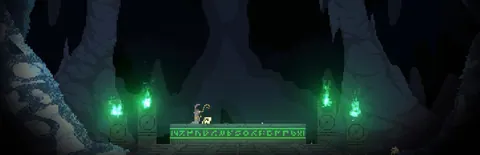
Prioritize Noita if changing terrain makes you curious about another solution. Its appeal is magic and the environment forming a problem together, beyond swapping visual effects within a fixed combat loop. For someone interested in interacting systems, that is a concrete reason to choose it.
Before buying, watch early exploration and a wand adjustment; notice whether pausing to understand an effect also interests you. Finished builds can hide that learning cost. Steam lists the official game as single-player; community multiplayer mods are outside this comparison.
Wizard of Legend
For practicing movement and spell sequences, with local co-op as an option

Prioritize the original Wizard of Legend if you want spells to become moves you personally execute. Its developers emphasize movement and combos and provide local co-op. Planning to play beside a friend makes that a practical purchasing difference.
Co-op does not automatically remove execution pressure. Watch movement and ability use in ordinary rooms, not only boss highlights. Remote streaming, native online play and local co-op are different features; check your target platform separately if you intend to play from different homes.
Choose the activity you want to repeat
For discovering how magic can change a world, prioritize Noita; for practicing how to connect a set of moves, prioritize Wizard of Legend. These are preference judgments grounded in official mechanics, not difficulty or completion-time guarantees. This article excludes Wizard of Legend 2 and does not apply old review prices, performance claims or controller restrictions to current versions.
Frequently asked questions
Is Noita a turn-based game that lets me think at my own pace?
No. It is real-time action. Studying spells and environments is part of the appeal, but does not remove the need to react during combat. If avoiding that pressure is your main requirement, look for a turn-based game instead.
Which should I consider for playing together on one screen?
Start with the original Wizard of Legend: its developer explicitly supports local co-op. Noita's official Steam feature list specifies single-player. Still check platform, input devices and any remote-streaming requirements before buying; this comparison makes no cross-platform multiplayer promise.
Sources and scope
Based on the sources below, checked on the dates shown; recommendations about fit are editorial judgments, not a hands-on play report or a difficulty measurement. This guide covers the named games, not their sequels. See each game page for review evidence.